
Hennepin County Probate Records Overview
Probate in Hennepin County is not handled by a separate county probate court. It is the Probate Division of Hennepin County District Court, grouped with Mental Health Court inside Minnesota's unified trial court system. The division handles the property of deceased persons, wills, trusts, guardianships, and conservatorships. Mental Health Court handles civil commitments based on allegations of mental illness, developmental disability, chemical dependency, and referrals from Criminal Court.
The official Hennepin Probate / Mental Health Court page is the local court source for division information. Its work sits within the Fourth Judicial District, so the same district court administration and Records Center channels apply when a person needs copies, public terminal access, or help finding a file that is not fully available through remote search.
The Probate / Mental Health Court source shows how the division is presented by the Minnesota Judicial Branch.
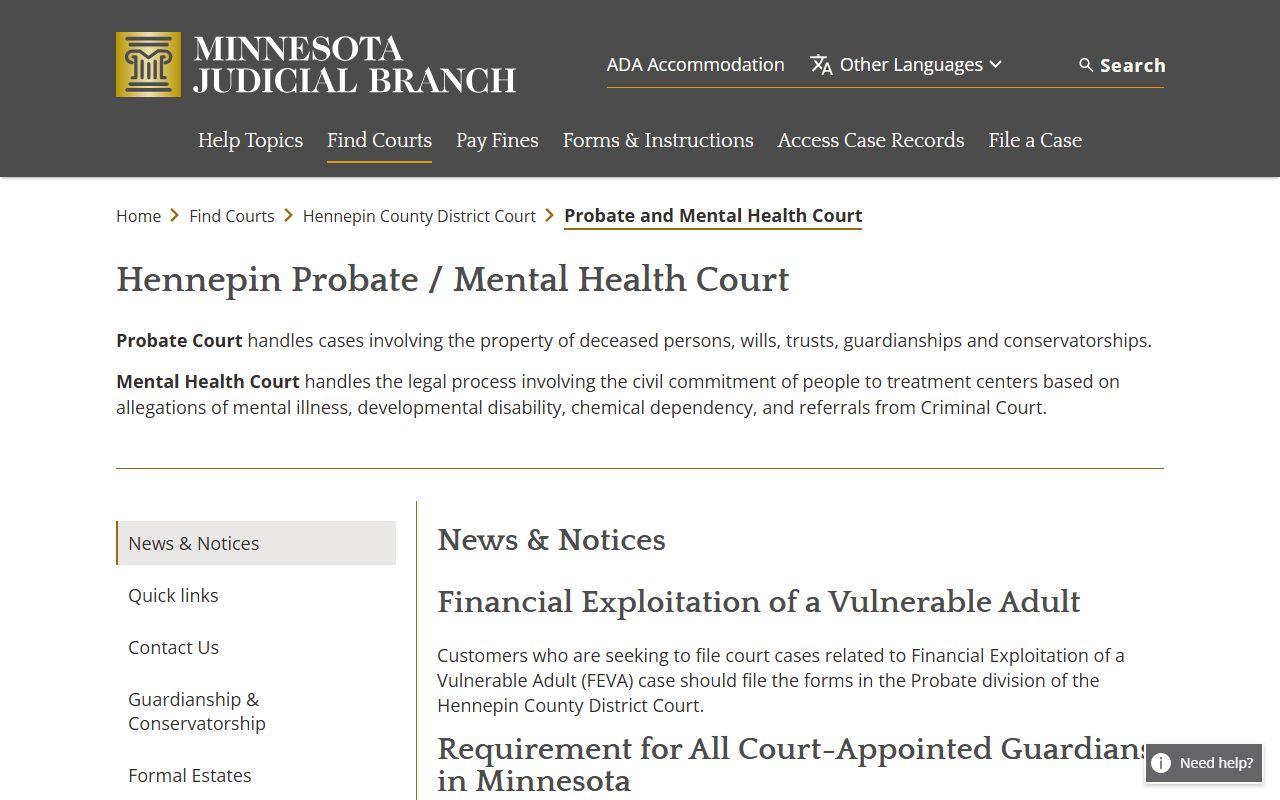
This matters because a Hennepin estate, guardianship, or conservatorship file is a District Court record, not a county recorder file or an independently elected clerk file.
Hennepin County Probate Court Contact
Probate and mental health filings are tied to the Hennepin County Government Center in downtown Minneapolis. Court Contact Center staff route general court questions, while the probate scheduling clerk is reached through the same court phone channel documented in the probate FAQ. Records Center access is on the B-Level of the Government Center for public terminals and court record requests.
Probate Division of Hennepin County District Court
Hennepin County Government Center
300 South 6th Street
Minneapolis, MN 55487
612-348-6000
8 a.m. to 4:30 p.m., Monday through Friday, closed holidays
Allow time for building security and for C-Tower navigation if a hearing, public terminal search, or Records Center visit is needed. The Government Center houses civil, criminal, family, housing, probate, mental health, and traffic court functions, so room assignments and division contacts should be checked before arrival.
Hennepin County Probate Terms
Probate files use terms that are precise but easy to confuse. A person named in a will does not gain legal power merely because the will names them. Hennepin's FAQ states that a nominated personal representative has no authority until the court probates the will and the representative qualifies. Letters are the proof of that authority.
- Testator
- The person who made a will.
- Personal representative
- The person appointed by the court to manage an estate. Other states may use executor.
- Intestate
- Dying without a valid will, so Minnesota succession law controls who inherits probate assets.
- Letters
- Certified court papers showing the personal representative has authority to act for the estate.
- Guardianship
- A court case giving someone power over personal decisions such as residence, medical care, training, or education.
- Conservatorship
- A court case giving someone power over financial decisions, bills, contracts, investments, and property management.
Search Hennepin County Probate Records
Start with MCRO Case Search for public probate and mental health case information. Choose the Probate or Mental Health case category and select Hennepin from the county list to keep statewide results from crowding the search. If the case number is known, use that number. If it is not known, search by party name, estate name, or related person where the system allows.
MCRO can show case information, Registers of Actions, hearing entries, and public documents when online access is allowed. MCRO Document Search is narrower because it requires the case number and only returns public documents available online. Public probate records available on courthouse terminals may still be unavailable on the internet because remote access is narrower than courthouse access.
- Search MCRO by name or case number, then set the court location to Hennepin County.
- Use the Probate or Mental Health category when the search form gives a case-category filter.
- Open the Register of Actions to check filings, hearings, orders, Letters, claims, and case status.
- Use Document Search only after a case number is known and only for public online documents.
- Contact the Hennepin Records Center for certified copies, older files, or records not available remotely.
The probate FAQ and legal help source adds the local filing and copy context for estate and guardianship users.
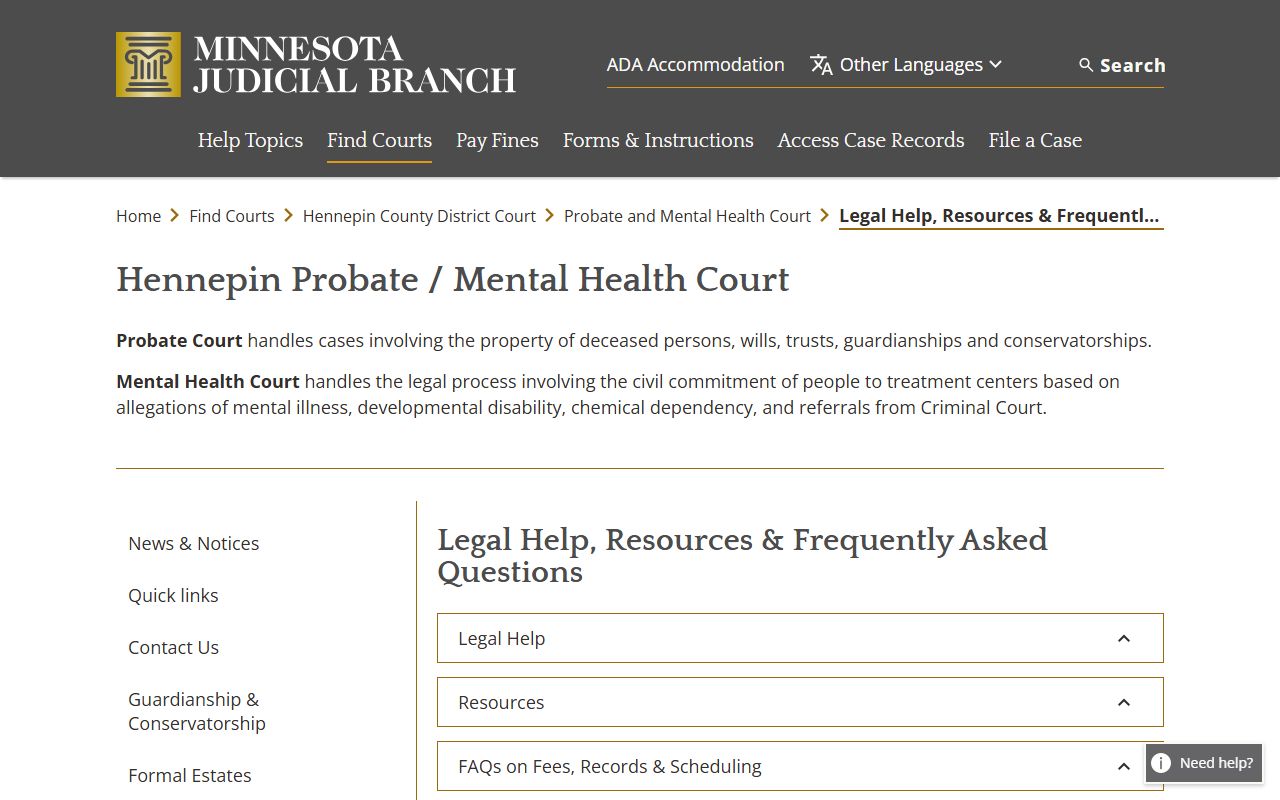
That source is useful when an MCRO entry shows a probate event but the reader still needs the right copy type, fee, or filing threshold.
Note: MCRO is not a certified court record, so legal use normally requires a copy issued by court administration.
Hennepin County Probate Thresholds
Hennepin's probate FAQ gives two practical thresholds for deciding whether a court proceeding may be needed. If the decedent owned real property in the decedent's name alone, of any value, some type of probate proceeding is needed. If the decedent owned personal property in the decedent's name alone with a total value above $50,000 on the date of death, probate is needed.
Probate assets are property owned in the decedent's name alone. Non-probate examples include joint tenancy, payable on death accounts, transfer on death designations, in trust for accounts, and named-beneficiary assets. A will does not avoid probate. A power of attorney also ends at death, so it cannot replace court appointment of a personal representative.
| Property situation | Hennepin probate rule |
|---|---|
| Real property in the decedent's name alone | Probate is needed regardless of value. |
| Personal property in the decedent's name alone above $50,000 | Probate is needed based on total date-of-death value. |
| Joint tenancy, POD, TOD, trust, or named beneficiary asset | Usually treated as non-probate property. |
| Will names a personal representative | No authority exists until the court acts and Letters issue. |
Hennepin County Probate Fees
Hennepin's Probate / Mental Health Court FAQ lists the filing and copy fees that matter most for estate, trust, guardianship, and conservatorship records. Plain copies of filed or unfiled documents and correspondence are listed as no-fee items in the FAQ, while certified and exemplified copies carry fixed per-copy charges.
| Item | Fee or rule |
|---|---|
| Open estate, trust, guardianship, or conservatorship | $322 filing fee |
| Certified copy of Letters | $14 per copy |
| Certified court copy | $14 per copy |
| Exemplified copy | $14 per copy |
| Plain copies of filed or unfiled documents and correspondence | No fee per probate FAQ |
| Estate sale paper set | Will, order or informal statement, and Letters, each $14 per certified document |
| Guardianship or conservatorship sale paper set | Order directing sale, order confirming sale, and Letters, each $14 per certified document |
Hennepin County Probate Letters
Letters are often the key probate record for banks, title companies, buyers, and agencies. They show that the personal representative or fiduciary has authority from the court. Hennepin's FAQ separates certified Letters from plain copies because certified Letters are used when a third party needs official proof. Estate sale papers usually include the will, order admitting the will or informal statement, and Letters.
Claims are part of the estate administration record. Hennepin notes that probate claims can be searched in MCRO. The creditor-claim period is tied to Minn. Stat. section 524.3-801, which the research identifies as the four-month period after the court administrator's notice. A Register of Actions may show claim filings, notices, orders, and related case events when public access rules allow display.
The creditor-claim statute source supports the four-month claims period used in Hennepin probate records.
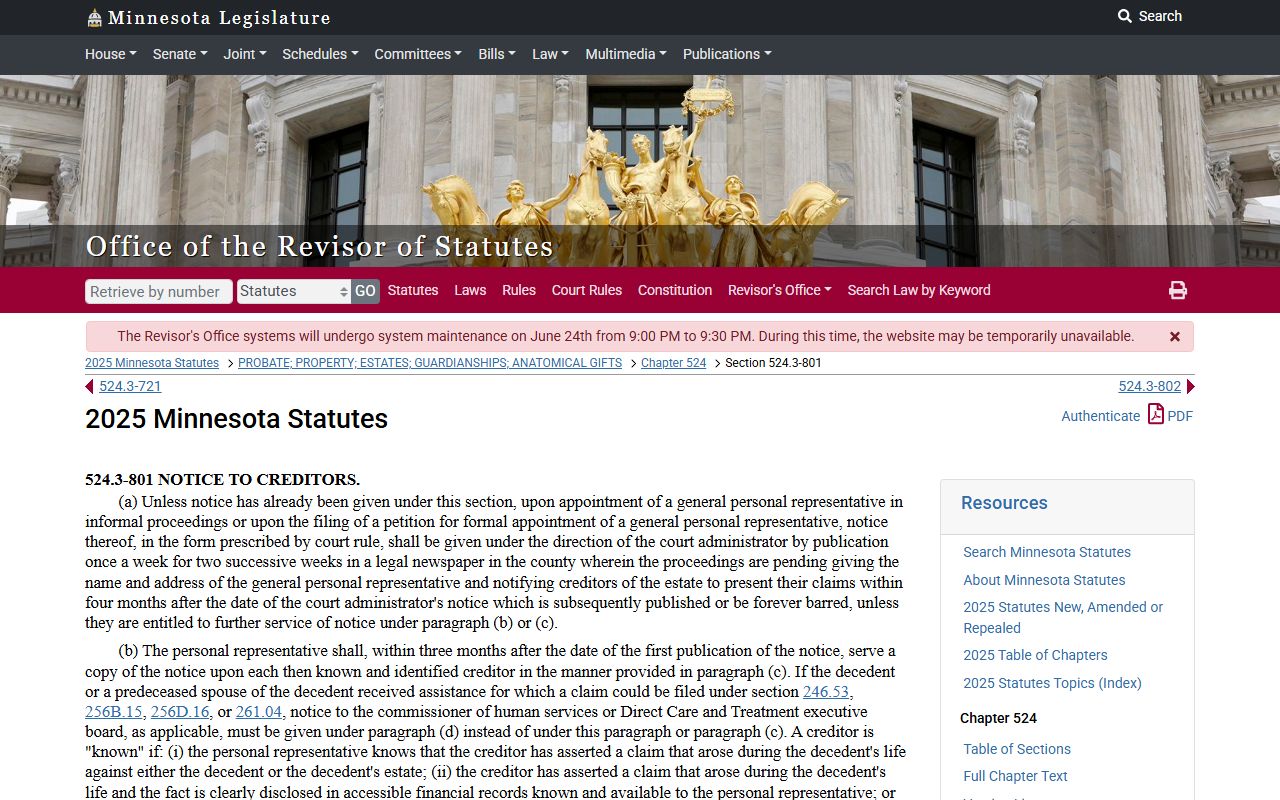
Use that timing with the court docket and filed notices, not as a substitute for legal advice in a contested estate.
Hennepin County Guardianship Records
Guardianship and conservatorship are related but different Hennepin probate case types. A guardian makes personal decisions for a person subject to guardianship, such as residence, medical decisions, training, and education. A conservator makes financial decisions, pays bills, invests assets, manages contracts, and handles property issues. Some cases involve both roles, but the powers must come from the court order.
The court visitor process is an important part of these cases. The visitor meets with the person subject to the petition, gives notice and petition materials, gathers views, evaluates the request and less restrictive alternatives, and files a written recommendation. After hearing, the court may grant the requested powers, grant limited powers, or dismiss the petition.
The Hennepin guardianship and conservatorship resource page links annual reporting materials and MyMNConservator resources for conservator reporting.
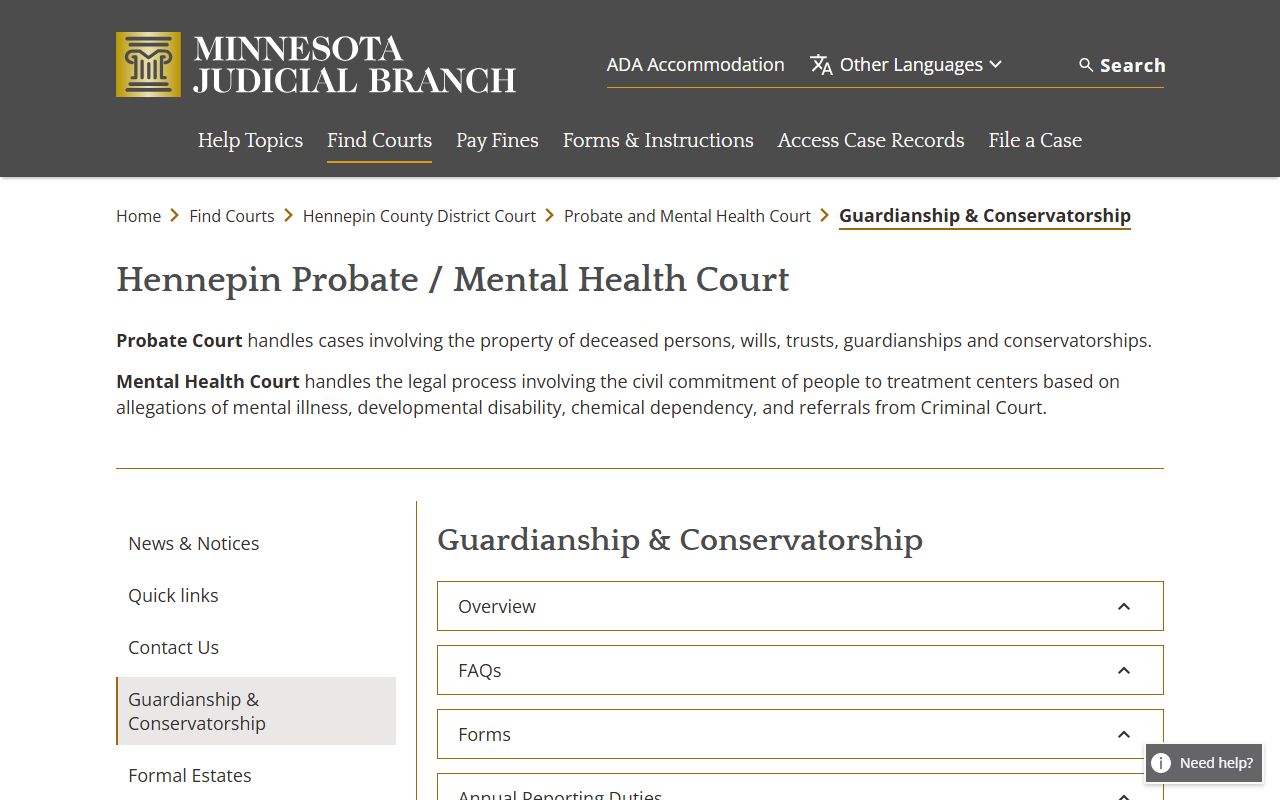
Those reporting duties explain why an active conservatorship file may contain annual accountings and later orders, not just the original appointment papers.
Restricted Hennepin County Probate Records
Public access varies by case type and document type. Formal probate, other probate, guardianship and conservatorship, and trust case documents filed after July 1, 2015 are among the public documents MCRO may provide online when access rules allow. Civil commitment documents are different. MCRO terms state that public documents in civil commitment case types are not available remotely.
Older records, sealed papers, protected personal identifiers, medical details, minor-related information, and some mental health records may require courthouse terminal access, a court order, or direct handling through court administration. The Minnesota Rules of Public Access to Records of the Judicial Branch, especially Rule 4 and Rule 8, explain why a document can be public at the courthouse but not posted on the internet.